
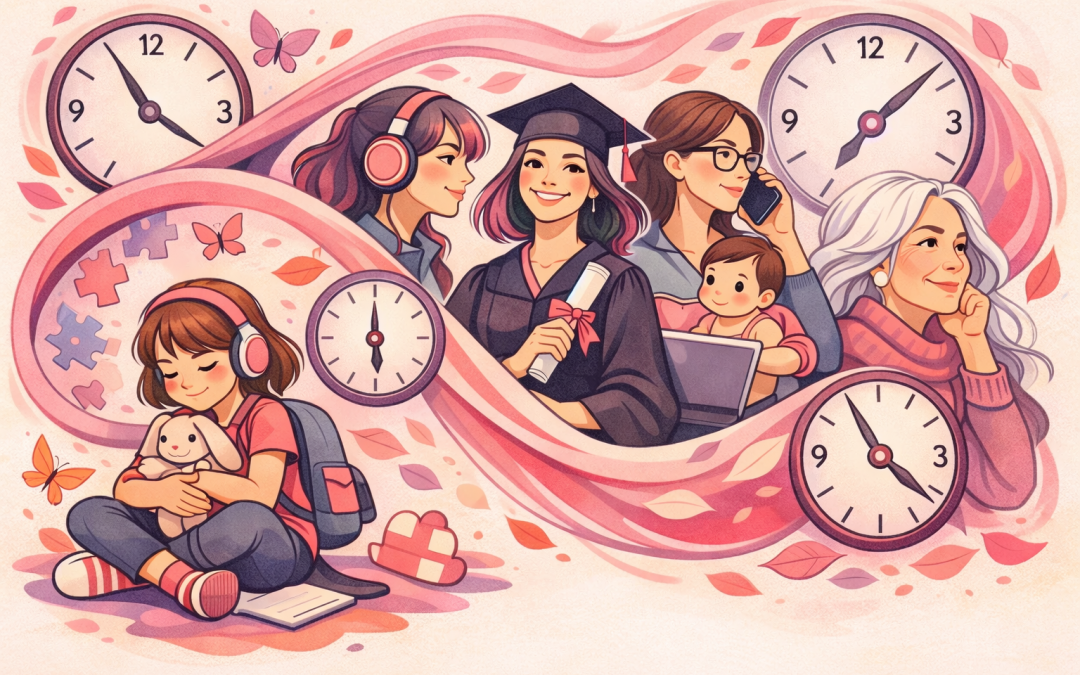
Every woman experiences her body as a dialogue with time. From childhood to old age, each of them goes through stages shaped entirely by hormonal changes, social pressures and accumulated silences. But when that woman is autistic, the experience becomes more complex: transitions can be more painful, diagnoses come late, and violence often goes unspoken. Some positive experiences are discovered late, or not at all, and with that, the balance risks being thrown off.
This article explores the stages of a woman’s life—childhood, adolescence, childbearing years, the menopause and old age—from a holistic perspective. This approach takes into account not only biological factors, but also emotional, social and unseen aspects. And at its heart lies a truth we cannot ignore: the experiences of autistic women at every stage of life deserve deep and specific attention.
Childhood: when the world still doesn’t understand
In their early years, girls discover the world with a sensitivity that is often perceived as a challenge. For girls with autism, this sensitivity may be particularly pronounced when it comes to stimuli such as sounds, lights or textures. Furthermore, in their daily lives they need clear routines and safe spaces where they can find refuge.
Violence in the lives of these girls can emerge at an early age: bullying that is less visible than in the case of boys, as it is not physical or direct but takes the form of exclusion or rumours; child sexual abuse; is more prevalent among autistic girls and women, partly because their vulnerability is perceived and they struggle to recognise appropriate levels of intimacy, their own emotions or safe contexts in which to seek help; this is even more dangerous when the girl cannot identify or express what is happening. Many adult women with autism recount abuse they suffered that went unnoticed, mistaken for shyness or a lack of understanding. The child’s body, which should be a refuge, can become a silenced space.
Adolescence: the battle of the lace
Adolescence marks the start of social expectations: one must ‘be a woman’. And no one really explains what that means, or how to go about becoming one. At this stage, menstruation begins, along with pressure to conform to beauty standards and the first romantic relationships. Young women with autism often face these changes with confusion, anxiety or distress.
So-called ‘masking’—the constant effort to appear ‘neurotypical’—is very common throughout this stage; in many cases, they have been doing this since childhood, and by the time they reach adolescence, these past habits cease to be the standard way of relating to others. Pretending all the time takes its toll, and sooner or later problems such as extreme exhaustion, anxiety or even depression begin to emerge. Some of these teenagers develop eating disorders or self-harm without knowing why. This is often associated with behavioural problems, but we must bear in mind that these behaviours are not merely acts of rebellion: they are a manifestation of pain and, in many cases, a response to complex trauma.
Reproductive age
During her childbearing years, a woman often finds herself caught between multiple roles, each with its own challenges and responsibilities: mother, non-mother, partner, professional, carer… Furthermore, hormonal changes continue, often leading to issues such as menstrual disorders, gynaecological problems and difficulties conceiving, which in turn compound other challenges such as exhaustion and the strain of parenting without support.
For women with autism, all these situations are experienced very differently and are often difficult to cope with. They may struggle to form relationships or to cope with the family dynamics of this stage; they may also enter into relationships as a further form of masking. Motherhood may be desired, but it can also be overwhelming; the perception of the bond or maternal instinct may not feel as expected and may be experienced with guilt, whilst sensory and personal overload presents an added challenge to life. Work may represent independence, but it is also a constant source of social anxiety. Furthermore, illnesses and health problems often go unnoticed, either because their pain threshold may be altered or because they simply do not know how to explain to the doctor what is happening to them; somatisation and musculoskeletal and hormonal problems are yet another example of clinical iatrogenesis in autism. They are expected to manage everything, but no one teaches them how to do so, nor provides them with the necessary tools or support. Some women choose to acknowledge their need for respite and respect their individuality, at a cost that requires considerable insight and support to cope with the loneliness at this stage, especially when, in adulthood, a diagnosis is sought or received, usually following life crises that can lead to a meltdown.
Menopause:
As the years go by, the onset of the climacteric (menopause) brings with it profound changes in many different aspects of life. The body changes, energy levels fluctuate and, in many cases, society’s view of women begins to shift: many women feel that they are no longer seen as desirable, valuable or relevant.
For women with autism, the symptoms associated with this stage may be experienced more intensely. Sensory and cognitive difficulties become more pronounced, and issues such as insomnia, night sweats or emotional dysregulation may intensify. For many, this stage also coincides with the time of diagnosis, and it is then that they are able to put a name to and understand the experiences they have gone through throughout their lives.
This is a time marked by grief, but also by understanding and, at times, by a fresh start.
Old age
As old age sets in, other challenges arise: chronic illnesses, a potential loss of independence, and the weight of grief accumulated over the course of a lifetime. Older women, in general, tend to experience higher levels of loneliness than men. For women with autism, this loneliness can be even more profound, as their social networks, which are already limited, become even smaller. Furthermore, health and support services are not always equipped to understand and adequately address the needs they present.
Furthermore, the risk of falls, malnutrition, osteoporosis – particularly in cases where an eating disorder has been present – and social isolation increases, as does the likelihood of experiencing violence or neglect. Many women live in fear of being institutionalised, of not being heard, and of losing the ability to make decisions about their own lives. At times like these, dignity depends more than ever on empathy, respect and human support.
Violence that permeates every stage
Throughout all stages of life, there is one painful constant that knows no age limits: violence. It can take the form of physical, sexual, emotional or even institutional abuse. Sometimes it is a blow. Other times, it is a doctor’s appointment where no one believes you. Or a partner who treats you like a child. Or sexual abuse that no one wanted to hear about.
Women with autism are particularly vulnerable to this violence. Due to their communication difficulties, their tendency to take things at face value, or their history of being ignored, they are often unable to recognise or defend themselves against abusive situations. The violence they experience is more persistent, and the system is less responsive.
Understanding the stages of a woman’s life cannot be limited to looking at her hormones. We must consider her history, her environment, and the things she leaves unsaid. And when that woman is autistic, we must look even deeper: we must learn from her language and the way she experiences the world.
Healthcare that takes gender and neurodiversity into account is not a luxury, but a necessity. It means asking questions with respect, listening without judgement, and offering time and genuine options. It means recognising that well-being is not just a matter of physical health, but of being able to live with dignity, support and authenticity.
We recommend
Takeda, Y. (2010). Understanding the life stages of women to enhance your practice. JMAJ, 53(5), 273-278.
The author emphasises that well-being at one stage directly influences the next, which means that doctors need to adopt a holistic approach that encompasses not only biomedical factors, but also psychological, social and cultural aspects. Understanding the socio-cultural context in which each woman lives helps to better understand her symptoms, identify underlying issues and offer more appropriate solutions.
In today’s society—which is very different from that of past generations—women face new challenges: delayed marriage, increased life expectancy, lower birth rates, and changing family roles. Despite legislative progress towards gender equality, many women still bear the brunt of domestic and caregiving responsibilities, which affects their mental health and quality of life.
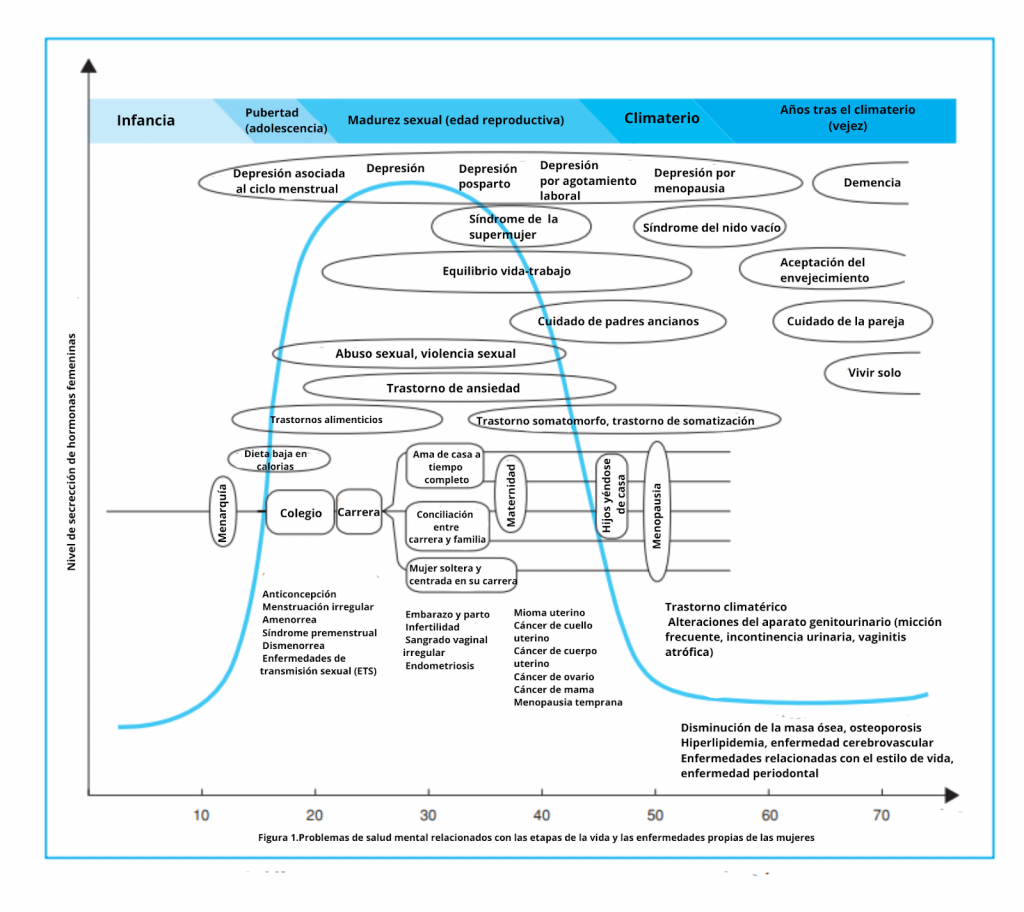
Takeda examines the specific issues at each stage:
- Puberty and adolescence: A stage of identity formation influenced by physical changes, social relationships and external pressures. There is an increase in sexually transmitted infections, eating disorders and difficulties in expressing emotions.
- Reproductive age: Gynaecological conditions, stress from balancing work and family life, ‘superwoman’ syndrome, and potential fertility issues may arise. The doctor plays a key role in providing guidance, listening to patients and referring them for specialist care where necessary.
- Menopause: This includes the menopause, which is accompanied by physical symptoms (hot flushes, sweating, mood swings) and conditions such as osteoporosis or cardiovascular disorders. Emotional changes also occur, linked to the ‘empty nest’ or caring for elderly parents.
- Old age: The risks of chronic illnesses, falls, loss of independence and loneliness increase. It is essential to listen to the patient, understand their support network and help them plan for their future care, including decisions regarding invasive treatments.
A key point of the article is the recognition of violence at every stage of life. Many women suffer physical or sexual abuse, including from childhood. These experiences have a profound and lasting impact on their physical and mental health. Healthcare staff must be trained to identify these situations, address them sensitively and offer appropriate support or referral.