
Dra María Merino Martínez
Social relationships and having a strong support network and circle of friends are positively associated with better quality of life and life expectancy (Holt-Lunstad, J., Smith, T. B., & Layton, J. B., 2010). It is considered a protective factor against the development of diseases linked to the autonomic nervous system, as well as a protective factor against life stressors such as illness, bereavement or other personal problems (Chang, L. C., Hsieh, P. C., & Huang, F. H., 2023, Karjalainen, S., Aro, T., & Parviainen, T., 2023).
Compared to autistic men, autistic women have a greater desire to socialise, feel more pressure to be included in the group and develop more camouflage strategies to achieve this goal; they also experience more relationship problems linked to emotional dysregulation, which does not always occur in social settings but is perceived as more concerning within the family environment (Figueroa, K., Baczewski, L., & Kasari, C. (2022). Friendships and Social Relationships of Autistic Individuals Across the Lifespan: A Focus on Often-Overlooked Autistic Women. In Handbook of Quality of Life for Individuals with Autism Spectrum Disorder (pp. 397–416). Cham: Springer International Publishing..
The difficulty in understanding the nature of human relationships—particularly when these relationships deliberately cause people suffering—is a specific and intense area of interest for many autistic women, as part of an ongoing quest not only to fit in but also to understand the many unspoken rules that apply solely when interacting with others (Leedham et al., 2020). They report feeling persistently undervalued or outright invalidated in various settings, including social, educational, work and family environments.
Most of these women experience an internal conflict between being themselves and facing the consequences they anticipate—namely loneliness—or trying to conform to the expectations they believe others may have of them, thereby exposing themselves to the unpredictable mix of acceptance and rejection. This unpredictable reinforcement sometimes acts as a glue to maintain dependent relationships; at other times, it leads to a change in strategy, such as seeking to interact individually and avoiding relationships with others. In many cases, when these patterns of rejection or intermittent reinforcement persist over time or across different contexts, they overwhelm the individual’s capacity to cope and expose them to the development of strategies that compromise their mental health. It also results in the experience of learned helplessness, which is the phenomenon underlying depression, whereby the person believes there is no valid strategy that will prevent their victimisation or pain, leading them to cease acting or lose interest in continuing to make an effort; in other words, it exhausts them and exposes them to the consequences of acute stress and complex trauma (Russo, F., 2018).
Camouflage is more common and generally more elaborate among autistic women than among autistic men; in this regard, we must not forget that gender is a deeply ingrained social structuring factor from childhood onwards: girls organise themselves into groups of girls and boys into groups of boys, the opportunity for mixed-gender interaction is limited and involves significant social pressure until adolescence, when these mixed-gender relationships begin to break down barriers and foster friendships that will aid in the subsequent development of romantic relationships, helping them recognise the foundations of a healthy relationship and distinguish it from an unhealthy one. (Tierney, S., Burns, J., & Kilbey, E. (2016) This ability to identify intent and to distinguish between right and wrong, or what is good or bad for me, is impaired in autism; in the case of women, it also carries a greater risk of sexual victimisation than in men. Thus, many women report that during their adolescence they had relationships with older men or people who repeatedly exploited them, or were victimised within the context of what they considered to be safe relationships or friendships. The pressure they feel to please others, not to say no, and the hope of being protected at any cost leaves them vulnerable, but so does the difficulty in identifying inappropriate relationship patterns in time, and the lack or absence of quality social support that could help them in this learning process that During adolescence, adults – whether family members or therapists – cannot fully replace the support provided by peers, as adolescents need unconditional support from their peers.
A disguised identity inherently involves viewing oneself as lacking in worth within social contexts, and this poses a serious threat to self-esteem. The question that needs to be asked is: to what extent should one compromise one’s natural self without invading or disrespecting others, yet without destroying one’s self-esteem by constructing a false identity that, sooner or later, becomes difficult to sustain and risks being seen as a personal fraud by those with whom one has the closest contact or intimacy?
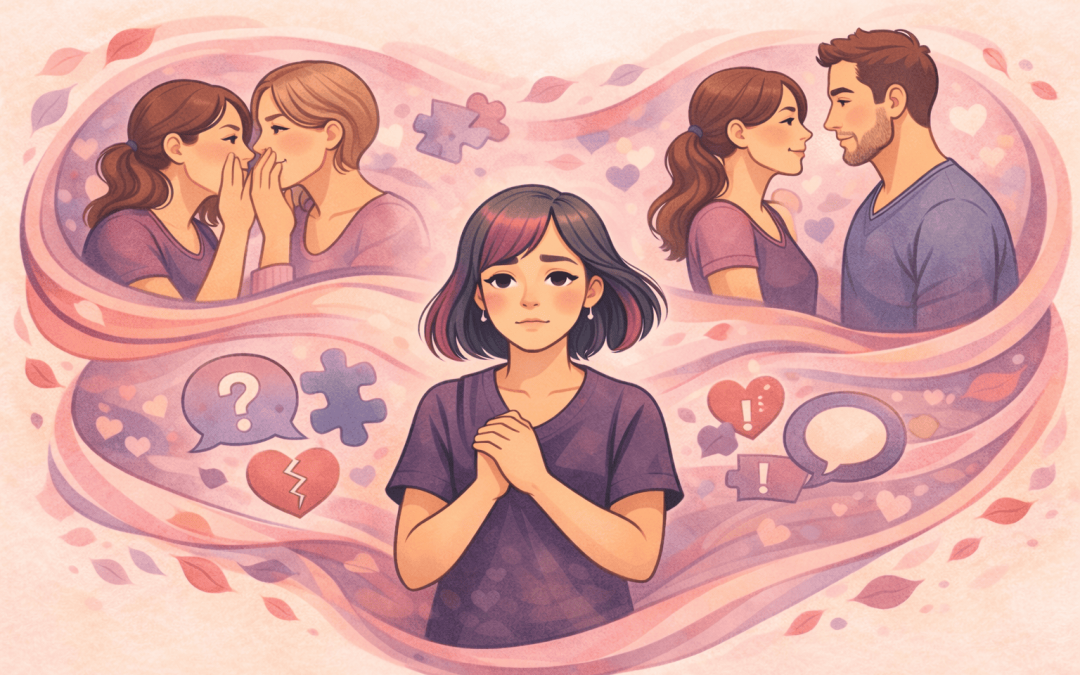
Learned behaviour and the intellectualisation of human behaviour can help us devise effective social strategies, such as saying hello – which carries the cultural meaning of telling the other person, ‘I recognise you and value you through this gesture’ – or letting someone know if we’ve accidentally damaged their belongings – ‘I need to tell you that I’ve accidentally stained the shirt you lent me; I’ve tried washing it but the stain hasn’t come out completely; is there anything I can do to make amends?” In this way, we are telling the other person: “I am an honest person and I am capable of acknowledging my mistakes, apologising and doing my best to make amends.” And this kind of social behaviour, which highlights the importance of coexistence and involves following explicit and implicit rules of social interaction so that we can all get on well together, requires effort on our part. However, in many cases, such ‘camouflage’ behaviour is not driven by a desire to respect boundaries, but rather by copying, imitation or a wish to fit in; in this sense, it involves acting in an unnatural way –I smile and say nice things to everyone because I think that’s how they’ll accept me, or, conversely, I gossip and speak ill of other girls because I’ve noticed this is a tactic other girls use to isolate a third person and thus remain in the group–.Such efforts may, to a greater or lesser extent, achieve their objectives or end in complete disaster, but there will always be people who sense that something is not quite right and feel uneasy and distrustful, because such behaviour is the basis of deception, and this results in a reduction in social support, or the need to seek out different groups or sources of support throughout life, which leads to exhaustion, a constant sense of uncertainty and a loss of our personal values.
From a personal perspective, I believe that the foundation for establishing and maintaining healthy interpersonal relationships lies, on the one hand, in making an effort to understand the social norms that entail respect and consideration for others, and in developing strategies to establish personal values that allow us to focus not on comparing ourselves with others, but on our own growth, whilst respecting our own identities, and, to a lesser extent, minimising the use of behaviours designed to please others that do not align with what we truly think or want. Perhaps following this approach may involve periods of solitude, but the likelihood of developing more authentic relationships with less social cost and less anxiety will increase.
The problem of loneliness and initial isolation is one of the greatest obstacles to forming relationships based on secure attachment. Women with autism feel that they have far less social support throughout their lives, and they feel insecure about their present and future, idealising the person who might come to their rescue or offer them unconditional support. The literature has for years described how autistic girls often have at least one friend who acts as a ‘mentor’, guiding them and whom they can emulate or spend time with to avoid being exposed to the extreme vulnerability of being alone. However, social support is not simply about having people around you, but the quality of that support; and in this case, many autistic women describe relationships of dependency, but also parasitic relationships in which they recognise their partners as the people who take the reins and take charge of managing aspects that pose a difficulty for them, such as arranging meetings with friends, dealing with bureaucracy, everyday decisions involving problem-solving, and even some parenting-related issues such as play or connecting with other groups of parents.
Given the types of relationships that can develop over the course of a lifetime, we cannot overlook the vital importance of the family, particularly in terms of self-esteem and life satisfaction; it is the primary source of support, and we expect the family to provide care that is unconditional. However, there are challenges arising from factors such as the influence of genetics, with one or both parents often having the condition even if they have never been diagnosed, or, in the case of adult women, facing the challenge of having one or more of their children who are also autistic. The greater and more constant perceived stress experienced by families can generate relationship patterns characterised by ‘expressed over-emotionality’; this is a term developed in the context of families with a member with a severe mental disorder, but which is frequently observed in clinical practice in families where there are autistic individuals. This consists of alternating between overprotective behaviours—where the difficulty is acknowledged and overcompensated for by trying to support the person, perhaps even beyond what they can or should attempt to do on their own—and patterns of hostility, where it is felt that the person is not doing everything they can and uses the diagnosis as a shield so that the family consents to the violation of certain boundaries.Boundaries which, on the other hand and due to these patterns—or at least in part—are unclear, inconsistent and lead the individual into a state of uncertainty and inappropriate reactions; this, in turn, reinforces the family system to a greater extent and generates tension and frustration amongst all family members.
Family stress is greater than in neurotypical families due to the additional difficulties arising from factors such as the extra support required for activities of daily living, and the time and financial costs of treatment. Examples of this can be found in the need for specific support in areas such as nutrition, a challenge that is heightened during adolescence, when anxiety, rigidity and sensory selectivity can lead to expressions of distress and the development of comorbidities such as eating disorders, but also in other difficulties associated with obsessive thoughts, anxiety, self-harm, premenstrual syndrome and reactive behaviours linked to acute stress or trauma, which are not isolated in these women.
References
Holt-Lunstad, J., Smith, T. B., & Layton, J. B. (2010). Social relationships and mortality risk: a meta-analytic review. PLoS Medicine, 7(7), e1000316.
Chang, L. C., Hsieh, P. C. & Huang, F. H. (2023). Are walking and social support in older adults always linked to autonomic nervous system function? A re-evaluation of an age-based moderation model. Geriatric Nursing, 51, 346–350.
Karjalainen, S., Aro, T. & Parviainen, T. (2023). Co-activation of the autonomic and central nervous systems during the processing of socially relevant information in autism spectrum disorders: A systematic review. Neuropsychology Review, 1–18.
Read the article: https://link.springer.com/article/10.1007/s11065-023-09579-2
Figueroa, K., Baczewski, L. & Kasari, C. (2022). Friendships and social relationships among people with autism across the lifespan: A focus on often-overlooked autistic women. In: Handbook on the Quality of Life of People with Autism Spectrum Disorders (pp. 397–416). Cham: Springer International Publishing.
Leedham, A., Thompson, A. R., Smith, R., & Freeth, M. (2020). ‘I was exhausted trying to figure it out’: The experiences of women receiving an autism diagnosis in middle to late adulthood. Autism, 24(1), 135–146.
Read the article: https://journals.sagepub.com/doi/full/10.1177/1362361319853442?fbclid=IwAR1bH5oLgQV6Bn1W7wWL0Pjzn9Qm52I6bMccbZpkiKSgJBxtgjKm95b1YOA&
Russo, F. (2018). The costs of hiding autism. Spectrum News, 21.
Article: The Costs of Russian Camouflage
Tierney, S., Burns, J., & Kilbey, E. (2016). Looking behind the mask: Social coping strategies of girls on the autistic spectrum. Research in Autism Spectrum Disorders, 23, 73-83.